I Trevail Once Again Until Christ Be Formed in You
St Austell
| |
|---|---|
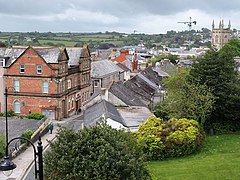 Loftier Cross Street | |
| St Austell Location within Cornwall | |
| Population | nineteen,958 (2011)[one] |
| OS grid reference | SX011524 |
| Civil parish |
|
| Unitary dominance |
|
| Ceremonial county |
|
| Region |
|
| Country | England |
| Sovereign state | United Kingdom |
| Postal service town | ST. AUSTELL |
| Postcode district | PL25 |
| Dialling code | 01726 |
| Police | Devon and Cornwall |
| Burn | Cornwall |
| Ambulance | South Western |
| UK Parliament |
|
| Website | www.staustell.co.u.k. |


St Austell (; Cornish: S. Austel)[3] is a boondocks in Cornwall, England, UK, 10 miles (16 km) southward of Bodmin and 30 miles (48 km) west of the border with Devon.[4]
St Austell is 1 of the largest towns in Cornwall; at the 2011 demography it had a population of 19,958.[1] [5]
History [edit]
St Austell was a village centred around the parish church, until the arrival of pregnant tin mining in the 18th century turned it into a town.
St Austell is named later on the 6th century Cornish saint, St Austol, a disciple of St Mewan. In a Vatican manuscript in that location is a 10th-century listing of Cornish parish saints. This includes Austoll, which means that the church and village existed at that time, soon after 900.[6]
St Austell is not mentioned in Domesday Volume (1086). Notwithstanding A. Fifty. Rowse, in his book St. Austell: Church, Town, and Parish, cites records which prove a church building was dedicated on 9 October 1262 by Bishop Bronescombe, and other records show a church there in 1169, dedicated to "Sanctus Austolus". The current church dates from the 13th–14th centuries, and was extended in 1498–99. The bring together between the two sections is still visible.[7]
In the time of Henry Viii, St Austell is described as a poor village. In John Leland's Itinerary he says, in around 1542, " At S. Austelles is nothing notable but the paroch chirch ".[8] Neither travel author, John Norden (c. 1547–1625) or Richard Carew (1555–1620) in his Survey of Cornwall mentioned St Austell equally a identify of whatsoever consequence. Oliver Cromwell granted a charter to hold a marketplace on Fri, as a advantage to a local admirer who fought for him at the boxing of Boconnoc.[9]
The hamlet started to grow in the 18th century. The nearby Polgooth mine became known as the greatest tin mine in the world. Effectually 1760 the Land'southward Finish to Plymouth road went through the town.[ten] Along with William Cookworthy's discovery of china clay at Tregonning Loma in west Cornwall, and the same mineral, institute in greater quantity in Hensbarrow downs north of St Austell, the town became more than prominent.[eleven]
China clay mining soon took over from tin and copper mining as the chief industry in the area, and this eventually contributed enormously to the growth of the town. The china clay industry really only came into its ain during the mid 19th to early 20th century, at a fourth dimension when the falling prices of tin and other metals forced many mines to shut downwardly or convert to clay mining. The success and loftier profitability of the manufacture attracted many families whose breadwinner had been put out of piece of work by the low in the local metal mining industry, and increased the population of the boondocks considerably. This meant that more than shops and businesses took root, providing more than jobs and improving merchandise. This, along with other factors, led to St Austell condign i of the 10 almost of import commercial centres of Cornwall.
The town was a noted eye of Methodism. Past 1839 The West Briton recorded 37 non-conformist chapels in the town.
Climate [edit]
| Climate data for St Austell 79m amsl (1981–2010) (extremes 1998–nowadays) | |||||||||||||
|---|---|---|---|---|---|---|---|---|---|---|---|---|---|
| Month | Jan | Feb | Mar | Apr | May | Jun | Jul | Aug | Sep | Oct | Nov | Dec | Year |
| Tape loftier °C (°F) | 13 (55) | 12 (54) | 16 (61) | 20 (68) | xx (68) | 25 (77) | 25 (77) | 24 (75) | 22 (72) | eighteen (64) | sixteen (61) | 14 (57) | 25 (77) |
| Average loftier °C (°F) | 9.3 (48.seven) | 9.one (48.4) | eleven.0 (51.8) | 12.8 (55.0) | 15.8 (sixty.iv) | 18.0 (64.4) | 20.iv (68.vii) | xx.3 (68.v) | 18.three (64.9) | 14.8 (58.6) | 12.0 (53.half-dozen) | nine.9 (49.8) | 14.3 (57.7) |
| Average depression °C (°F) | 3.8 (38.8) | 3.vii (38.vii) | 4.8 (40.six) | 5.4 (41.7) | 7.ix (46.two) | 10.6 (51.1) | 12.ix (55.2) | 12.8 (55.0) | 11.0 (51.8) | 8.9 (48.0) | six.iii (43.3) | four.iii (39.7) | 7.7 (45.eight) |
| Record low °C (°F) | −1 (30) | −4 (25) | −4 (25) | 2 (36) | 6 (43) | 9 (48) | 11 (52) | 11 (52) | 8 (46) | 6 (43) | 2 (36) | ane (34) | −4 (25) |
| Average rainfall mm (inches) | 134.ii (five.28) | 103.1 (four.06) | 97.1 (3.82) | 77.3 (iii.04) | 70.2 (2.76) | 71.0 (two.80) | 79.half-dozen (3.thirteen) | 74.7 (2.94) | 89.9 (3.54) | 129.7 (5.xi) | 144.two (5.68) | 135.1 (5.32) | 1,206.i (47.48) |
| Average rainy days (≥ 1.0 mm) | 16.7 | 12.viii | 14.5 | eleven.ix | 10.7 | ix.6 | 10.4 | eleven.2 | xi.1 | 15.viii | 16.8 | 16.2 | 157.7 |
| Hateful monthly sunshine hours | 49.7 | 71.0 | 108.v | 172.8 | 184.one | 178.2 | 182.7 | 172.7 | 135.ix | 91.four | 67.6 | 46.half dozen | 1,461.2 |
| Source 1: Met Office[12] | |||||||||||||
| Source 2: MSN weather[xiii] | |||||||||||||
Redevelopment [edit]
Work began in 1963 on a brutalist-fashion pedestrian precinct which included shops, offices, and flats. The pattern was by Alister MacDonald & Partners and the materials reinforced concrete with some stone facing.[fourteen]
In the 2000s this area of the boondocks had get very outdated, and underwent a £75 meg redevelopment procedure. In Baronial 2007, developers David McLean and demolition team Gilpin moved onto the town middle site to consummate the preparation, with the Filmcentre which was originally an Odeon movie theatre dating back to 1936, beingness demolished in late September/early October.[ citation needed ]
In October 2007, the South West of England Regional Development Bureau (SWRDA) announced the new development would be named White River Place. Information technology was also appear that 50% of shop units had been leased to Loftier Street stores,[15] with New Await, Peacocks, Bonmarché and Wilko opening new stores. This would hateful New Wait relocating from its current premises in Fore Street and the return of Peacocks to St Austell post-obit the sabotage of its former shop to make way for the new development. Bonmarche has since closed.[ citation needed ]
It was appear in October 2008 that the programmer David McLean Developments had gone into administration and business organisation was expressed that this could jeopardise the completion of the projection.[16]
The new White River Cinema opened its doors in December 2008 for the start time: the movie house is technically avant-garde and the showtime purpose-built cinema in Cornwall for over 60 years. The Torchlight Carnival was revived[ clarification needed ] in November 2009 as a direct effect of public demand through a survey conducted with local residents. The Torchlight Procession has become an of import upshot in the town's agenda, heralding in the Winter celebrations and drawing thousands of people from beyond Cornwall and Devon. The event is run past a small group of not-affiliated volunteers.[ citation needed ]
The St Austell and Clay State Eco-town is a program for several new settlements around St Austell on quondam Imerys sites. It was given outline regime approval in July 2009.[17]
The Cornwall Council strategic planning committee voted in July 2011 to approve a £250 million beach resort scheme at Carlyon Bay, St Austell. The development was initially proposed in 2003.[eighteen] [xix]
Governance [edit]

The arms of St Austell are Arg. a saltire raguly Gu.[xx]
Parliamentary [edit]
St Austell is in the parliamentary constituency of St Austell and Newquay which was created in 2010 by the Boundary Commission for England (increasing the number of seats in Cornwall from five to six). Before 2010 information technology was in the Truro and St Austell seat.
Local regime [edit]
The main local authority is Cornwall Council, the unitary authority created every bit office of the 2009 structural changes to local government in England.[21] The half dozen old Districts and the onetime Cornwall County Council were abolished and replaced by Cornwall Council on i April 2009.
Too on one April 2009, iv new parishes were created for the St Austell expanse.[22] They are:
- St Austell Town Council covering Boscoppa, Bethel, Gover, Mount Charles, Poltair and Holmbush; represented past 20 councillors.
- Carlyon Parish Quango covering Carlyon Bay and Tregrehan; represented past 9 councillors.
- St Austell Bay Parish Council covering Charlestown, Duporth, Porthpean and Trenarren; represented by 7 councillors.
- Pentewan Valley Parish Council roofing Tregorrick, Trewhiddle, London Apprentice and Pentewan; represented by 9 councillors.[23] [24]
Earlier this date the area had been an unparished area.
Economy [edit]
St Austell is the main centre of the mainland china clay industry in Cornwall and employs around two,200 people as of 2006[update], with sales of £195 million.[25] [26]
The St Austell Brewery, which historic its 150th ceremony in 2001, supplies cask ale to pubs in Cornwall and other parts of the land. Its flagship beer is St Austell Tribute; a number of other ales are brewed simply are less normally sold outside Cornwall. St Austell Brewery's first public business firm, The 7 Stars Inn, purchased in 1863, still stands today on East Colina in the boondocks. Tregonissey House, the site of the company's first steam Brewery, built in 1870, tin as well be seen in Market place Hill. A brewery museum and visitor center is open up to the public on the nowadays brewery site in Trevarthian Route.
Tourism [edit]
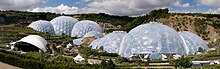
Panoramic view of the geodesic biome domes at the Eden Project
As in much of Cornwall and neighbouring counties, tourism is increasingly of import to St Austell'south economy. Tourists are drawn to the area by nearby beaches and tourist allure such as the Eden Project, sited in a former dirt pit, and the Lost Gardens of Heligan. The China Dirt Country Park, in a old china-clay pit 2 miles (3.2 km) north of the boondocks, tells the story of the men, women and children who lived, worked and played in the shadow of the clay tips around St Austell.
St Austell is domicile to several public houses, numerous high street retailers, and several independent shops, many of which cater for tourists. The boondocks has a small museum which is situated in the Market place Firm. A Brewery Museum and Visitor Centre is situated on the site of the St Austell Brewery in Trevarthian Route.
Paper and radio [edit]
The boondocks has two weekly newspapers:
- St Austell Guardian, function of the Cornish Guardian series published by Cornwall and Devon Media Ltd, has a long history in the town and is published on Friday.
- St Austell Vocalization, sister paper to the Newquay Voice, had offices close to the boondocks center in Truro Road, simply has since moved to Onetime Vicarage Place. Information technology is published on Midweek
Radio St Austell Bay is a local radio station which broadcasts from studios at Tregorrick Park. It launched in January 2008 to cover the area from Trewoon in the west to Tywardreath in the east.
Landmarks [edit]

Holy Trinity Church, St Austell
Notable Cornish builder Silvanus Trevail designed a number of St Austell'southward buildings and houses, including the Thin Finish and the Moorland Road terrace. Other notable architects from St Austell include John Goode, who contributed considerably during the 1970s to residential developments in the area.
Pevsner remarks in his guide to Cornwall that the post-obit buildings are notable:[14]
- The Parish Church
- The Onetime Market Hall, in Italian Renaissance style, 1844
- Friends Meeting House, 1829, a obviously granite construction
- Masonic Hall, South Street, 1900[27] and is home to nine Masonic bodies[28]
- White Hart Hotel: once contained panoramic wallpaper of the Bay of Naples by Dufour (now in the Victoria and Albert Museum)[29]
- Holy Well at Menacuddle
- 3 buildings of the 1960s: Penrice School, 1960; Public Library, 1961; former Magistrates' Courtroom, 1966
Transport [edit]
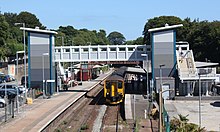
St Austell railway station was opened by the Cornwall Railway on 4 May 1859 on the hillside above the town centre. Two co-operative lines west of the town were later opened to serve the china clay industry; the Newquay and Cornwall Junction Railway which is nevertheless partly open, and the short-lived Trenance Valley line.[xxx] The independent narrow gauge Pentewan Railway ran from W Hill to the coast at Pentewan. The Cornish Main Line in St Austell is quite renowned for its viaducts in the Gover Valley and Trenance areas of the boondocks. The original timber structure was designed past Isambard Kingdom Brunel, it was 115 feet (35 yard) high, 720 anxiety (220 1000) long on x piers; it was replaced by a new stone viaduct in 1899.[31] [32]
At that place was a siding located west of the viaduct. In the early years trains from St Austell had to button wagons over the tall, curving viaduct to shunt this siding. The Peachy Western Railway's instructions stated that: "Trucks may exist pushed from St Austell to the Siding, but when this is washed the speed of the Train between the two places must not exceed 8 miles an hour, and the head Guard must ride on the leading vehicle, unless it be a bonnet terminate one, in which example he must ride in the first low sided vehicle from it, to keep a good await out, and be prepared to give a bespeak to the Commuter either by Solar day or Night, as may be required". Railroad train services today operate west to Truro and Penzance, and east to Plymouth and London. In that location are also CrossCountry services on well-nigh days to the North of England and Scotland.[33]
The boondocks's bus station faces the entrance to the railway station to offer an like shooting fish in a barrel interchange betwixt buses and trains. National Express motorcoach services call here, a dedicated link operates to the Eden Project, and local buses operate to villages such every bit Fowey and Mevagissey. The boondocks tin can be accessed by the A390 which by-passes the town to the s on its way from Liskeard to Truro, or past the A391 from Bodmin, or by the A3058 from Newquay. In improver there are the B3273 to Mevagissey, the B3274 to Padstow and the A3082 to Fowey.
St Austell bus station [edit]

St Austell bus station in June 2013
St Austell motorbus station is the primary bus and coach terminus for the town. The coach station is located in the forecourt of the railway station, formerly a railway appurtenances yard.
The coach station was redeveloped once more in 2008, the new facility beingness opened on 3 November. It now comprises 7 stands and shares facilities such every bit a taxi rank and cafe with the bordering railway station which is operated by Great Western Railway, a sister company to the main local jitney operator. Local services are provided by Start Kernow. Long-distance coach services are part of the National Limited Coaches network.
History [edit]
The Great Western Railway started to operate what they called 'road motors' from exterior their railway station on three August 1908. These outset services ran to St Columb Road via St Dennis.
A jitney garage was later provided nearby in Eliot Road, next to the railway'southward new goods yard. The network was progressively extended over the next xx years, afterwards which time the services were transferred to the Western National Jitney Company, formed in 1929 to free the railway visitor from its bus services and avoid complaints about its transport monopoly.[34] Western National has now become part of the FirstGroup and operates as Offset Kernow.[ commendation needed ]
Educational activity [edit]
St Austell has three comprehensive schools, Poltair School, formerly the grammer school, and Penrice Academy; together with Brannel Schoolhouse which is situated in the nearby village of St Stephen-in-Brannel. Several of these are joining an academy trust called CELT (Cornwall Didactics and Learning Trust).[35]
Cornwall College St Austell is a Farther & College Education institution incorporating the former St Austell 6th Grade Centre and Mid Cornwall College of Farther Instruction. The college is based at John Keay Firm, which is also home to the college grouping's headquarters.
In that location are a number of chief schools inside the town.[36]
Health services [edit]

St Austell Community Hospital

St John'south Methodist Church (built 1828 and restored in 1882)
St Austell has its own hospital, St Austell Community Infirmary, formerly chosen Penrice Infirmary.[37]
Religious sites [edit]
The church was originally defended to St Austol, a Breton saint associated with St Meven, only is now dedicated to the Holy Trinity. By 1150 it had been appropriated to the Priory of Tywardreath by the Cardinhams: this continued until 1535. In that location was originally a Norman church here, of which some remains may be seen.
The present church building is of the 15th century and is large considering the mediaeval parish was as well a big ane: the tower is impressive. All iv outside walls bear sculptural groups in carved niches: the Twelve Apostles in 3 groups on the north, east and southward; the Holy Trinity to a higher place the Annunciation and below that the Risen Christ between ii saints on the westward. The tower can be dated to between 1478 and 1487 by the arms of Bishop Courtenay, and the walls are faced in Pentewan stone.[38]
The tower and other parts of the church have an interior lining of granite[39] On the south side of the church, a formerly split up chantry has been incorporated into the church when it was extended. (The altar itself was abolished in 1543.)
At that place are holy wells at Menacuddle and Towan.[xl] A new organ was placed on the north side of the chancel in 1880 and the first recital was held on 22 April. The organ was congenital by Messrs Bryceson Brothers and Ellis and toll circa £600.[41] The church building is dedicated to the Holy Trinity, is Form I listed, and seats 300.[42] There is a Cornish cross in the churchyard which was found cached in the basis on the manor of Treverbyn in 1879.[43] This cross was erected in the churchyard on a new base in 1879. Another cross is in the grounds of a business firm originally known every bit Moor Cottage. This house was congenital in 1819; the cross was brought from Hewas in the parish of Ladock.[44]
The parish of St Austell was part of the archdeaconry of Cornwall and Diocese of Exeter until 1876 when the Diocese of Truro was established. A new rural deanery of St Austell was established in 1875. The way of worship of the parish church building is in the Evangelical tradition of the Church of England. The ii chapels-of-ease are All Saints, Pentewan, and St Levan's, Higher Porthpean. In the 19th century the following parishes were created out of St Austell parish: St Blazey (1845); Charlestown (1846), Treverbyn (1847), and Par (1846 out of St Blazey and Tywardreath).
Quakers [edit]
In that location was formerly a Quaker burial ground at Tregongeeves, just outside the town on the Truro Road. It was covered by most half-dozen ft (1.8 m) of earth removed from the edifice of the new road in the 1960s. A high stone wall bounds the remaining acre of state; access can be gained through a wrought iron gate.
Approximately forty of the headstones from Tregongeeves were removed and are now located at the Friends meeting house in the High Cross Street in St Austell, just below the high wall which surrounds St Austell railway station. That meeting business firm is still in utilize.
Sport [edit]
Speedway [edit]
Speedway racing first took place a venue called Rocky Park, under the name "St Austell Gulls". The sport was a hit during various years, between 1949 and 1963 at the Cornish Stadium. The sport returned to the surface area in the late 1990s, in the Clay Country Moto Parc, located at Old Pound, Nanpean.
The gild operated equally the St Austell Gulls for 4 years, until the club changed buying, and moved up a league to the Premier League, re-formed as the Trelawny JAG Tigers, until site owners Imerys Minerals Ltd ended the lease. Speedway has not been held in Cornwall since. Many attempts have been made to re-introduce the sport, but none have got past planning permission. The two highest profile bids were at Par Moor Motor Museum and St Eval Raceway. The owner of the land for the Par Moor bid confirmed that he would rent the land for speedway but locals objected. The St Eval bid failed after residents expressed fears about racket.
Stock car racing [edit]
Stock car racing, promoted past 1950s Kiwi Speedway star Trevor Redmond, ran adjacent with speedway on numerous occasions. Numerous championships were run here, including the 1972 BriSCA World Championship for Formula two cars, won by Jimmy Murray from Northern Republic of ireland. It closed its doors in 1987.
Greyhound racing [edit]
A greyhound racing track was also opened at the Cornish Stadium and traded from 1958 to 1986. The racing was independent (not affiliated to the sports governing trunk the National Greyhound Racing Guild) and was known as a flapping track, which was the nickname given to independent tracks.[45] [46]
Football [edit]
St Austell Football Club was formed on 17 September 1890. In 1908 the club won its commencement trophy: the Cornwall Charity Cup. The club achieved some success in the late 1920s and 1930s, winning the Senior Cup and Clemency Cup twice. In May 2009, the team won the Senior Loving cup with a closely fought 3–two victory over Saltash United.[47]
Rugby and lawn tennis [edit]
Tregorrick Park is the home of St Austell RFC, St Austell Lawn tennis Gild and Cornwall Table Tennis Centre. St Austell RFC play in the Tribute Western Counties West league and the order supports two senior teams, a ladies team and xiv youth teams covering nigh age groups. Founded in 1963 St Austell RFC has played at the Tregorrick Park ground since their move from Cromwell Route in the 1980s to brand fashion for the Asda supermarket.
Tregorrick Park also hosts a gym, sports hall, squash courts, bar, function room and holds local events such as firework displays and schools cantankerous country competitions.
Cricket [edit]
Wheal Eliza cricket ground is the home of St Austell Cricket Lodge, and is also used for Minor Counties matches. The club supports 4 senior teams, a ladies' team and youth teams. Facilities at Wheal Eliza includes two playing fields with their own changing room facilities enabling the order to hold two competitive matches every lucifer day. The club also has a pavilion, scorebox, artificial and grass nets.
Baseball [edit]
In 2017, the St Austell Claycutters baseball game club was established to compete in the S West Baseball League. While the team are named and associated with St. Austell, all outdoor preparation and dwelling games are held on the sports fields at Fowey River Academy in Fowey.[ citation needed ]
See also [edit]

- Boscoppa, a suburb of St Austell
- Carclaze. a suburb of St Austell
- Charlestown, the port of St Austell
- St Austell with Fowey, a former local government expanse
- St Stephen-in-Brannel, a commune of hamlet near St Austell
- Sticker, a village near St Austell
- Treverbyn, a nearby village and parish
- Trewoon, a village near St Austell
- People from St Austell
- HMS St Austell Bay (K634)
References [edit]
- ^ a b UK Demography (2011). "Local Area Report – St Austell Parish (1170220638)". Nomis. Role for National Statistics. Retrieved 20 March 2018.
- ^ "About St Austell - St Austell Boondocks Council".
- ^ "List of Place-names agreed past the MAGA Signage Panel" (PDF). Cornish Language Partnership. May 2014. Archived from the original (PDF) on 29 July 2014. Retrieved 11 Jan 2015.
- ^ Ordnance Survey: Landranger map sheet 200 Newquay & Bodmin ISBN 978-0-319-22938-5
- ^ "Data from the 2011 Demography (Office for National Statistics)". Cornwall Quango. Archived from the original on 3 December 2013. Retrieved 15 November 2013.
- ^ "The first mention of St Austell, ca. 900 AD, in a Vatican manuscript" – Roger Pearse, 2020.
- ^ St Austell Parish Church website, visited eleven May 2020.
- ^ Leland, John (1964). "Office III". In Lucy Toulmin Smith (ed.). Leland's Itinerary in England and Wales. Vol. I. London: Centaur Press. p. 202.
- ^ Frederick Wilton Litchfield Stockdale, Excursions in the canton of Cornwall, p.62.
- ^ Gilbert, Davies (1838). The Parochial History of Cornwall. London: J. B. Nicholls and Son. p. 47.
- ^ Smith, John R. (1992). "Cookworthy and the Early on Years". Cornwall'southward China-Clay Heritage. Twelveheads: Twelveheads Printing/Cornwall Archaeological Unit. p. 3. ISBN0-906294-25-8.
- ^ "St Austell Climate Catamenia: 1981–2010". Met Part. Retrieved 10 November 2018.
- ^ "Records and Averages". MSN. 12 November 2018. Retrieved 23 November 2018.
- ^ a b Pevsner, N. (1970) Cornwall; 2nd ed. Penguin Books; pp. 156–58
- ^ Cornish Guardian, three October 2007
- ^ Cornish Guardian, 27 October 2008.
- ^ "Eco-town home page". Cornwall Quango. Retrieved 7 November 2010.
- ^ "'Globe-class' development approved for Carlyon Bay". Cornish Guardian. Archived from the original on 17 September 2012.
- ^ "Carlyon Bay development given the go ahead". BBC News. 30 June 2011. Retrieved 26 November 2017.
- ^ Pascoe, W. H. (1979). A Cornish Armory. Padstow, Cornwall: Lodenek Printing. p. 134. ISBN0-902899-76-vii.
- ^ "Cornwall (Structural Change) Gild 2008". Office of Public Sector Data. 25 February 2008. Retrieved 21 September 2009.
- ^ "Town and parishes to get councils". BBC News website. BBC. five December 2008. Retrieved 6 Dec 2008.
- ^ [1] Cornwall Quango website (1). Retrieved May 2010
- ^ [ii] Cornwall Council website (2). Retrieved May 2010
- ^ British Geological Survey (January 2006). "Kaolin Mineral Planning Factsheet" (PDF). Office of the Deputy Prime Minister. Retrieved 9 June 2013.
- ^ Imerys Minerals Limited (2003) Blueprint: Vision for the Hereafter
- ^ Cryer, Revd N B (1989) Masonic Halls of England: The South Shepperton: Ian Allan, pp 107–114
- ^ Province of Cornwall (2012) Cornwall Masonic Year Book 2012–2013
- ^ "Vues d'Italie; La Baie de Naples". Victoria and Albert Museum.
- ^ Bennett, Alan (1988). The Great Western Railway in Mid Cornwall. Southampton: Kingfisher Railway Publications. ISBN0-946184-53-iv.
- ^ Binding, John (1993). Brunel'southward Cornish Viaducts. Penryn: Atlantic Send Publishing/Historical Model Railway Club. ISBN0-906899-56-7.
- ^ "St Austell Viaduct - St. Austell". wikimapia.org.
- ^ "National Runway Timetable 135 (Wintertime 2008)" (PDF). Network Rail. Retrieved 23 Feb 2009.
- ^ Cummings, John (1980). Railway Motor Buses and Bus Services in the British Isles 1902–1933, book two. Headington: Oxford Publishing Company. ISBN0-86093-050-5.
- ^ "Academies". Cornwall Education Learning Trust . Retrieved 9 July 2020.
- ^ "All Schools In St Austell, Cornwall|Schools Insight". www.schoolsinsight.co.uk . Retrieved 9 July 2020.
- ^ "Cornwall bucks negative tendency as midwife-led birthing centre opens 24/7". Cornwall Alive. 3 Apr 2019. Retrieved 10 January 2020.
- ^ Pevsner, Northward. (1970) Cornwall; 2d ed., revised by Enid Radcliffe. Penguin Books
- ^ Roberts, E. (1967) The Story of St Austell Parish Church Ramsgate: The Church Publishers
- ^ Cornish Church building Guide (1925) Truro: Blackford; p. 57
- ^ "St Austell. Organ Recital On The New Church Organ". The Cornishman. No. 94. 29 April 1880. p. 7.
- ^ Truro Diocesan Directory 2008. Truro Diocesan Lath of Finance. pp. 60–61.
- ^ Langdon, A. G. (1896) Old Cornish Crosses. Truro: Joseph Pollard; p. 253
- ^ Langdon, A. Thousand. (2002) Stone Crosses in Mid Cornwall; second ed. Federation of Old Cornwall Societies; p. 22
- ^ Barnes, Julia (1988). Daily Mirror Greyhound Fact File, page 419. Ringpress Books. ISBN0-948955-fifteen-5.
- ^ "St Austell Greyhound Stadium". Greyhound Racing Times. 3 February 2019.
- ^ "Order history". St Austell AFC. Archived from the original on 17 May 2008. Retrieved 24 June 2009.
Further reading [edit]
- Hammond, Joseph (1897) St Austell: being an business relationship of St Austell, boondocks, church, commune and people. London: Skeffington & Son
- Rowse, A. L. (1960) St Austell: Church, Town, Parish. St Austell: H. East. Warne
- Roberts, E (1967) The Story of St Austell Parish Church, Ramsgate: The Church Publishers
External links [edit]
 | Wikimedia Commons has media related to St Austell. |
- St Austell Town Council
- St Austell at Curlie
- Cornwall Record Part Online Catalogue for St Austell Archived 3 March 2016 at the Wayback Machine
-
 St Austell travel guide from Wikivoyage
grantsholexpeetry1946.blogspot.com
Source: https://en.wikipedia.org/wiki/St_Austell
0 Response to "I Trevail Once Again Until Christ Be Formed in You"
Post a Comment